You are using an out of date browser. It may not display this or other websites correctly.
You should upgrade or use an alternative browser.
You should upgrade or use an alternative browser.
Coronavirus
- Thread starter poolman
- Start date

Help Support Hardline Crawlers:


muddinmetal
Guntersville, AL
I have made a killing on futures stocks predicting a down turn in the market. It has affected neither me nor my family in any immediate way other than that. Yet. It really isn't that deadly, it's just new and social media is feeding the hysteria in a way we have never seen before.

zukimaster
Hold my beer and watch this!
Its those communist democrats and China trying there best to take Trump down.
kevinhumphrey
Well-Known Member
- Joined
- Feb 4, 2014
- Messages
- 327
- Reaction score
- 2
Its those communist democrats and China trying there best to take Trump down.
Its those communist democrats and China trying there best to take Trump down.
kevinhumphrey
Well-Known Member
- Joined
- Feb 4, 2014
- Messages
- 327
- Reaction score
- 2
Yes
kevinhumphrey
Well-Known Member
- Joined
- Feb 4, 2014
- Messages
- 327
- Reaction score
- 2
Not sure how or why that Copied the previous post still trying to figure out this new hardline 1st time I’ve posted or replied in a while but yes the world is against Trump



As an Amazon Associate we earn from qualifying purchases. Product prices and availability are accurate as of the date/time indicated and are subject to change.

clutchee
Well-Known Member
- Joined
- Jan 2, 2012
- Messages
- 263
- Reaction score
- 50
In auto industry it’s interesting.... some OEMs mentioning issues but most trade shows or gatherings are cancelled. Lots of “precautions” being taken, company issued a “no travel” to any foreign country..... and domestic is at your own choice or management approval based on need.
I’m hearing customers cancel meetings based on keeping non essential personal out.
Lots of media hype..... think it’s funny, folks are cleaning like they always should have but now it’s as if they are scrubbing for the plague....
Been wanting to see if we have made it this long with mediocre cleaning process what kinda stuff are they killing off cleaning as if it’s end of man kind.
I’m hearing customers cancel meetings based on keeping non essential personal out.
Lots of media hype..... think it’s funny, folks are cleaning like they always should have but now it’s as if they are scrubbing for the plague....
Been wanting to see if we have made it this long with mediocre cleaning process what kinda stuff are they killing off cleaning as if it’s end of man kind.
muddinmetal
Guntersville, AL
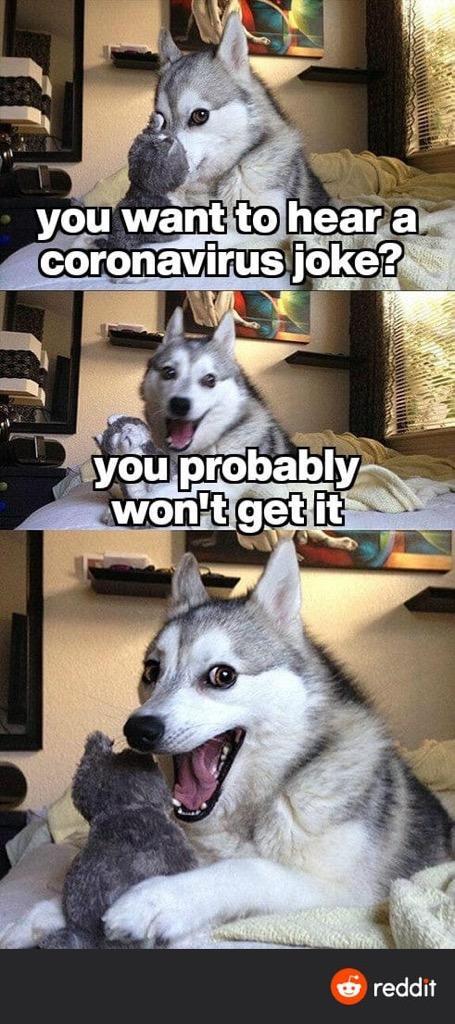
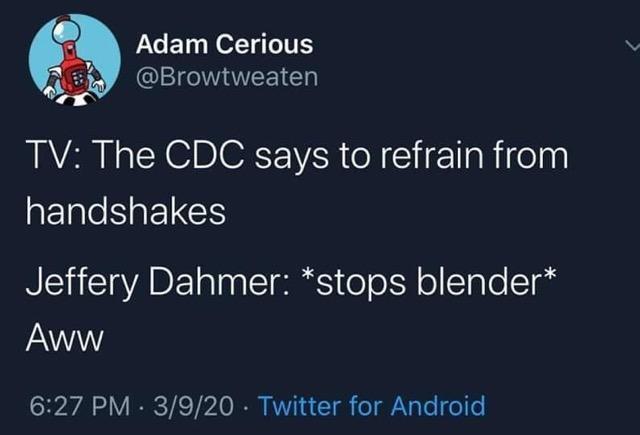
I am sure you are trying to be serious here, but these got sent to me today and since they are on topic...

TBItoy
Well-Known Member
we have 3 machines on the floor that are in limbo because of travel restrictions. Can't get parts to run/debug one, can't get customers here for acceptance/training,
Most of our customers are international.
Luckily we got a local-ish job lined up (no air travel required).
I'd say business will be pretty slow this year overall.
We're spread out enough in the US that I don't think we'll see the absolute over-whelming of health services that other places have (see northern Italy).
It's gonna suck the economy down for a while because everything is a huge continuous flow.
Most of our customers are international.
Luckily we got a local-ish job lined up (no air travel required).
I'd say business will be pretty slow this year overall.
We're spread out enough in the US that I don't think we'll see the absolute over-whelming of health services that other places have (see northern Italy).
It's gonna suck the economy down for a while because everything is a huge continuous flow.

Eddyj
Well-Known Member
long version:
It has completely shut my business down 100%
it has crippled the entire industry. Dear friends of mine will lose 50% of their annual income in the next 11 days. But there cost to operate will stay the same.
I am praying that someone will make a stand against the immediate cancellation of all events were groups larger than 250 are held. Unfortunately our current “don’t upset no one” and “let’s stop a 1000 people from enjoying themselves if 1 person is offended” way of thinking society has adopted, things are going to get much worse before they return to normal.
I could type for an hour but it will do no good...
It has completely shut my business down 100%
it has crippled the entire industry. Dear friends of mine will lose 50% of their annual income in the next 11 days. But there cost to operate will stay the same.
I am praying that someone will make a stand against the immediate cancellation of all events were groups larger than 250 are held. Unfortunately our current “don’t upset no one” and “let’s stop a 1000 people from enjoying themselves if 1 person is offended” way of thinking society has adopted, things are going to get much worse before they return to normal.
I could type for an hour but it will do no good...
Eddyj
Well-Known Member
Short version: I hate people

Beerj
Sonzabitches!
Nothing directly here yet but we've cancelled a number of trains and ridership has dropped tremendously. I think they said cancellations have gone up like 300% but that should drop back down if people stop booking. From a trackwork perspective, I'd think now would be a good time to get some work done in tough areas now that there's less traffic. However, my wife is a conductor so there's a possibility that she could see a furlough if they cancel enough trains. Guess we'll see...
Beerj
Sonzabitches!
Says the guy who makes a living making people happy. But seriously, hope this blows over quickly for everyone's sake.Short version: I hate people


xjmarc
Wannabe Bouncer
We're starting to see it at our restaurant. They are telling people to stay home and cancelling meetings, we do a decent bit of catering. Also the colleges are going to be online only for a while and we cater several meetings a month with our local one, UTC. They cancelled a good half dozen already. I'd be surprised if we make it through the year.

ridered3
Not Rigless
Says the guy who makes a living making people happy. But seriously, hope this blows over quickly for everyone's sake.
I thought he was a carnival guy, not a street walker...

Same for us. And our office campus is closed for nowVerizon has basically shut us down for any travel. Everything is online or over the phone at this point.

617_Racing
Well-Known Member
Travel is suspended and sounds like I'll be told to work from home starting next week.
zukimaster
Hold my beer and watch this!
Just to show you this panic is political charged, in the last 10 years there was N1H1, Ebola, swine flu, that killed tons more people and alot more dangerous, but that was when Obama was in office and the news loved him and it was no big deal, now the crazy fake news and left wing idiots are creating a panic and wrecking the stock market, just to try and pull Trump down! It's crazy to think these people would like to see millions of people suffer financially to just get at Trump!

jeeptj99
Well-Known Member
Im making a killing because everyone is buying ammo. Not sure why but yall go ammo. I'm trying to buy cool **** for my ****box

Trailabite
Well-Known Member
Schools are closed here in Fulton County GA. My company has requested us not to travel for work, which is going to be hard to do. We have a lot of project managers that travel all over the place to run jobs.
jeeptj99
Well-Known Member
Schools are closed here in Fulton County GA. My company has requested us not to travel for work, which is going to be hard to do. We have a lot of project managers that travel all over the place to run jobs.
One of our competitors has issued a statement that no outside reps are allowed in and if you fly for any reason you're automatically quarantined for 14 days.

tallnate
Well-Known Member
Just to show you this panic is political charged, in the last 10 years there was N1H1, Ebola, swine flu, that killed tons more people and alot more dangerous, but that was when Obama was in office and the news loved him and it was no big deal, now the crazy fake news and left wing idiots are creating a panic and wrecking the stock market, just to try and pull Trump down! It's crazy to think these people would like to see millions of people suffer financially to just get at Trump!
The problem with this covid19 virus is how quickly and easily it's spreading. Ebola, Nipah, Sars, Mers were all deadlier yes but their total number of cases combined was no where near the currently confirmed number of cases of coronavirus and that number grows faster every day. Coronavirus is killing 3.4% of the people it infects where as H1N1 killed 0.02%. If the coronavirus spreads to 61 million people like the H1N1 virus did it will become the deadliest outbreak in history by a long shot. Trump didn't just suspend international travel on a whim, he did because this is an extremely serious outbreak.

matlock
Well-Known Member
Much of the current discourse on — and dismissal of — the Covid-19 outbreak focuses on comparisons of the total case load and total deaths with those caused by seasonal influenza. But these comparisons can be deceiving, especially in the early stages of an exponential curve as a novel virus tears through an immunologically naïve population.
Perhaps more important is the disproportionate number of severe Covid-19 cases, many requiring hospitalization or weekslong ICU stays. What does an avalanche of uncharacteristically severe respiratory viral illness cases mean for our health care system? How much excess capacity currently exists, and how quickly could Covid-19 cases saturate and overwhelm the number of available hospital beds, face masks, and other resources?
This threat to the health care system as a whole poses the greatest challenge.
As of March 8, about 500 cases of Covid-19 had been diagnosed in the U.S. Given the substantial underdiagnosis at present due to limitations in testing for the coronavirus, let’s say there are 2,000 current cases, a conservative starting bet.
We can expect a doubling of cases every six days, according to several epidemiological studies. Confirmed cases may appear to rise faster (or slower) in the short term as diagnostic capabilities are ramped up (or not), but this is how fast we can expect actual new cases to rise in the absence of substantial mitigation measures.
That means we are looking at about 1 million U.S. cases by the end of April; 2 million by May 7; 4 million by May 13; and so on.
As the health care system becomes saturated with cases, it will become increasingly difficult to detect, track, and contain new transmission chains. In the absence of extreme interventions like those implemented in China, this trend likely won’t slow significantly until hitting at least 1% of the population, or about 3.3 million Americans.
What does a case load of this size mean for health care system? That’s a big question, but just two facets — hospital beds and masks — can gauge how Covid-19 will affect resources.
The U.S. has about 2.8 hospital beds per 1,000 people (South Korea and Japan, two countries that have seemingly thwarted the exponential case growth trajectory, have more than 12 hospital beds per 1,000 people; even China has 4.3 per 1,000). With a population of 330 million, this is about 1 million hospital beds. At any given time, about 68% of them are occupied. That leaves about 300,000 beds available nationwide.
The majority of people with Covid-19 can be managed at home. But among 44,000 cases in China, about 15% required hospitalization and 5% ended up in critical care. In Italy, the statistics so far are even more dismal: More than half of infected individuals require hospitalization and about 10% need treatment in the ICU.
For this exercise, I’m conservatively assuming that only 10% of cases warrant hospitalization, in part because the U.S. population is younger than Italy’s, and has lower rates of smoking — which may compromise lung health and contribute to poorer prognosis — than both Italy and China. Yet the U.S. also has high rates of chronic conditions like cardiovascular disease and diabetes, which are also associated with the severity of Covid-19.
At a 10% hospitalization rate, all hospital beds in the U.S. will be filled by about May 10. And with many patients requiring weeks of care, turnover will slow to a crawl as beds fill with Covid-19 patients.
If I’m wrong by a factor of two regarding the fraction of severe cases, that only changes the timeline of bed saturation by six days (one doubling time) in either direction. If 20% of cases require hospitalization, we run out of beds by about May 4. If only 5% of cases require it, we can make it until about May 16, and a 2.5% rate gets us to May 22.
But this presumes there is no uptick in demand for beds from non-Covid-19 causes, a dubious presumption. As the health care system becomes increasingly burdened and prescription medication shortages kick in, people with chronic conditions that are normally well-managed may find themselves slipping into states of medical distress requiring hospitalization and even intensive care. For the sake of this exercise, though, let’s assume that all other causes of hospitalization remain constant.
Let me now turn to masks. The U.S. has a national stockpile of 12 million N95 masks and 30 million surgical masks for a health care workforce of about 18 million. As Covid-19 cases saturate nearly every state and county, virtually all health care workers will be expected to wear masks. If only 6 million of them are working on any given day (certainly an underestimate) they would burn through the national N95 stockpile in two days if each worker only got one mask per day, which is neither sanitary nor pragmatic.
It’s unlikely we’d be able to ramp up domestic production or importation of new masks to keep pace with this level of demand, especially since most countries will be simultaneously experiencing the same crises and shortages.
Shortages of these two resources — beds and masks — don’t stand in isolation but compound each other’s severity. Even with full personal protective equipment, health care workers are becoming infected while treating patients with Covid-19. As masks become a scarce resource, doctors and nurses will start dropping from the workforce for weeks at a time, leading to profound staffing shortages that further compound the challenges.
The same analysis applied to thousands of medical devices, supplies, and services — from complex equipment like ventilators or extracorporeal membrane oxygenation devices to hospital staples like saline drip bags — shows how these limitations compound one another while reducing the number of options available to clinicians.
Importantly — and I cannot stress this enough — even if some of the core assumptions I’m making, like the fraction of severe cases or the number of current cases, are off even by several-fold, it changes the overall timeline only by days or weeks.
Unwarranted panic does no one any good, but neither does ill-informed complacency. It’s inappropriate to assuage the public with misleading comparisons to the seasonal flu or by assuring people that there’s “only” a 2% fatality rate. The fraction of cases that are severe really sets Covid-19 apart from more familiar respiratory illnesses, compounded by the fact that it’s whipping through a population without natural immune protection at lightning speed.
Individuals and governments seem not to be fully grasping the magnitude and near-inevitability of the national and global systemic burden we’re facing. We’re witnessing the abject refusal of many countries to adequately respond or prepare. Even if the risk of death for healthy individuals is very low, it’s insensible to mock decisions like canceling events, closing workplaces, or stocking up on prescription medications as panicked overreaction. These measures are the bare minimum we should be doing to try to shift the peak — to slow the rise in cases so health care systems are less overwhelmed.
The doubling time will naturally start to slow once a sizable fraction of the population has been infected due to the emergence of herd immunity and a dwindling susceptible population. And yes, societal measures like closing schools, implementing work-from-home policies, and canceling events may start to slow the spread before reaching infection saturation.
But considering that the scenarios described earlier — overflowing hospitals, mask shortages, infected health care workers — manifest when infections reach a mere 1% of the U.S. population, these interventions can only marginally slow the rate at which our health care system becomes swamped. They are unlikely to prevent overload altogether, at least in the absence of exceedingly swift and austere measures.
Each passing day is a missed opportunity to mitigate the wave of severe cases that we know is coming, and the lack of widespread surveillance testing is simply unacceptable. The best time to act is already in the past. The second-best time is right now.
Perhaps more important is the disproportionate number of severe Covid-19 cases, many requiring hospitalization or weekslong ICU stays. What does an avalanche of uncharacteristically severe respiratory viral illness cases mean for our health care system? How much excess capacity currently exists, and how quickly could Covid-19 cases saturate and overwhelm the number of available hospital beds, face masks, and other resources?
This threat to the health care system as a whole poses the greatest challenge.
As of March 8, about 500 cases of Covid-19 had been diagnosed in the U.S. Given the substantial underdiagnosis at present due to limitations in testing for the coronavirus, let’s say there are 2,000 current cases, a conservative starting bet.
We can expect a doubling of cases every six days, according to several epidemiological studies. Confirmed cases may appear to rise faster (or slower) in the short term as diagnostic capabilities are ramped up (or not), but this is how fast we can expect actual new cases to rise in the absence of substantial mitigation measures.
That means we are looking at about 1 million U.S. cases by the end of April; 2 million by May 7; 4 million by May 13; and so on.
As the health care system becomes saturated with cases, it will become increasingly difficult to detect, track, and contain new transmission chains. In the absence of extreme interventions like those implemented in China, this trend likely won’t slow significantly until hitting at least 1% of the population, or about 3.3 million Americans.
What does a case load of this size mean for health care system? That’s a big question, but just two facets — hospital beds and masks — can gauge how Covid-19 will affect resources.
The U.S. has about 2.8 hospital beds per 1,000 people (South Korea and Japan, two countries that have seemingly thwarted the exponential case growth trajectory, have more than 12 hospital beds per 1,000 people; even China has 4.3 per 1,000). With a population of 330 million, this is about 1 million hospital beds. At any given time, about 68% of them are occupied. That leaves about 300,000 beds available nationwide.
The majority of people with Covid-19 can be managed at home. But among 44,000 cases in China, about 15% required hospitalization and 5% ended up in critical care. In Italy, the statistics so far are even more dismal: More than half of infected individuals require hospitalization and about 10% need treatment in the ICU.
For this exercise, I’m conservatively assuming that only 10% of cases warrant hospitalization, in part because the U.S. population is younger than Italy’s, and has lower rates of smoking — which may compromise lung health and contribute to poorer prognosis — than both Italy and China. Yet the U.S. also has high rates of chronic conditions like cardiovascular disease and diabetes, which are also associated with the severity of Covid-19.
At a 10% hospitalization rate, all hospital beds in the U.S. will be filled by about May 10. And with many patients requiring weeks of care, turnover will slow to a crawl as beds fill with Covid-19 patients.
If I’m wrong by a factor of two regarding the fraction of severe cases, that only changes the timeline of bed saturation by six days (one doubling time) in either direction. If 20% of cases require hospitalization, we run out of beds by about May 4. If only 5% of cases require it, we can make it until about May 16, and a 2.5% rate gets us to May 22.
But this presumes there is no uptick in demand for beds from non-Covid-19 causes, a dubious presumption. As the health care system becomes increasingly burdened and prescription medication shortages kick in, people with chronic conditions that are normally well-managed may find themselves slipping into states of medical distress requiring hospitalization and even intensive care. For the sake of this exercise, though, let’s assume that all other causes of hospitalization remain constant.
Let me now turn to masks. The U.S. has a national stockpile of 12 million N95 masks and 30 million surgical masks for a health care workforce of about 18 million. As Covid-19 cases saturate nearly every state and county, virtually all health care workers will be expected to wear masks. If only 6 million of them are working on any given day (certainly an underestimate) they would burn through the national N95 stockpile in two days if each worker only got one mask per day, which is neither sanitary nor pragmatic.
It’s unlikely we’d be able to ramp up domestic production or importation of new masks to keep pace with this level of demand, especially since most countries will be simultaneously experiencing the same crises and shortages.
Shortages of these two resources — beds and masks — don’t stand in isolation but compound each other’s severity. Even with full personal protective equipment, health care workers are becoming infected while treating patients with Covid-19. As masks become a scarce resource, doctors and nurses will start dropping from the workforce for weeks at a time, leading to profound staffing shortages that further compound the challenges.
The same analysis applied to thousands of medical devices, supplies, and services — from complex equipment like ventilators or extracorporeal membrane oxygenation devices to hospital staples like saline drip bags — shows how these limitations compound one another while reducing the number of options available to clinicians.
Importantly — and I cannot stress this enough — even if some of the core assumptions I’m making, like the fraction of severe cases or the number of current cases, are off even by several-fold, it changes the overall timeline only by days or weeks.
Unwarranted panic does no one any good, but neither does ill-informed complacency. It’s inappropriate to assuage the public with misleading comparisons to the seasonal flu or by assuring people that there’s “only” a 2% fatality rate. The fraction of cases that are severe really sets Covid-19 apart from more familiar respiratory illnesses, compounded by the fact that it’s whipping through a population without natural immune protection at lightning speed.
Individuals and governments seem not to be fully grasping the magnitude and near-inevitability of the national and global systemic burden we’re facing. We’re witnessing the abject refusal of many countries to adequately respond or prepare. Even if the risk of death for healthy individuals is very low, it’s insensible to mock decisions like canceling events, closing workplaces, or stocking up on prescription medications as panicked overreaction. These measures are the bare minimum we should be doing to try to shift the peak — to slow the rise in cases so health care systems are less overwhelmed.
The doubling time will naturally start to slow once a sizable fraction of the population has been infected due to the emergence of herd immunity and a dwindling susceptible population. And yes, societal measures like closing schools, implementing work-from-home policies, and canceling events may start to slow the spread before reaching infection saturation.
But considering that the scenarios described earlier — overflowing hospitals, mask shortages, infected health care workers — manifest when infections reach a mere 1% of the U.S. population, these interventions can only marginally slow the rate at which our health care system becomes swamped. They are unlikely to prevent overload altogether, at least in the absence of exceedingly swift and austere measures.
Each passing day is a missed opportunity to mitigate the wave of severe cases that we know is coming, and the lack of widespread surveillance testing is simply unacceptable. The best time to act is already in the past. The second-best time is right now.
Trailabite
Well-Known Member
Just to show you this panic is political charged, in the last 10 years there was N1H1, Ebola, swine flu, that killed tons more people and alot more dangerous"
N1H1 and Swine Flu are the same.
61 million infected, 575,400 died over a 14 month period. .9% death rate.
Ebola
28,616 infected, 11,310 died over a 3 year period. 40% death rate.
SARS
8098 infected, 774 died over a 12 month period. 9.6% death rate.
COVID-19
130,307 infected, 4,756 died over a 2 month 1 week period. 3.6% death rate. This is just starting!
Lil ugly
Well-Known Member
My business has not been affected yet but I am sure it will be if this ramps up. I am not medically competent or aware but I have been telling the wife that the reaction to this was out of proportion to it being something as simple as the flu. They dont quarantine people with the flu. Matlock's post atleast gives an idea of why something like this can be so serious. If you take a look at secondary issues such as sanitation pick up and other necessary services that will be impacted by the lack of enough labor force it starts to seem a little more like it will hit close to home. What really really sucks is I am almost done with my 8 friggin year build of my buggy. Like end of the month done, and this is going to stop my willingness to travel for a bit.
I’ve already had a couple of friends affected. I have started looking for work for multiple people in hopes to help them get by this year. The amusement industry is seeing record losses. Disney is getting raped right now and it is just going to roll down hill.

j-mox
Well-Known Member
My job is sold out business right now with this! I make toilet paper. We went from getting ready to idle a line to now can’t make shipments. Bad thing is when all this blows over it will probably drop to nothing for awhile due to everyone will be stocked up.

ToledoDan
Well-Known Member
- Joined
- Sep 8, 2017
- Messages
- 236
- Reaction score
- 15
School is cancelled next week in SE Houston (CCISD)/(this week is our spring break). Houston ISD has cancelled through March 30th.
Cancelled the Houston Rodeo - bad news for a lot of vendors.
My nephews go to school in NW Ohio - currently school is canceled in all of Ohio until April 6th.
Church services/meetings are temporaily suspended Worldwide for The Church of Jesus Christ of Latter Day Saints.
Normally when we see oil prices drop, we see a drop in the price of steel, in the past when steel prices have dropped it has worked out well for us since we produce welded steel storage tanks, and our customers can take advantage of lower material costs-but who knows this time.
If work sends us home, I'm loading up all my junk and going wheelin!
Cancelled the Houston Rodeo - bad news for a lot of vendors.
My nephews go to school in NW Ohio - currently school is canceled in all of Ohio until April 6th.
Church services/meetings are temporaily suspended Worldwide for The Church of Jesus Christ of Latter Day Saints.
Normally when we see oil prices drop, we see a drop in the price of steel, in the past when steel prices have dropped it has worked out well for us since we produce welded steel storage tanks, and our customers can take advantage of lower material costs-but who knows this time.
If work sends us home, I'm loading up all my junk and going wheelin!
TBItoy
Well-Known Member
My job is sold out business right now with this! I make toilet paper. We went from getting ready to idle a line to now can’t make shipments. Bad thing is when all this blows over it will probably drop to nothing for awhile due to everyone will be stocked up.
We were talking this morning about how the papermills will try to ramp up, miss their numbers, flood the market, then lay eveyone off just in time for Christmas
Latest posts
-
-

-
-
-
-
-
-

-
-
-
For Sale First Generation 4Runner Rock Crawler for sale or trade
- Latest: FirstGenFunRunner
-
-
-
Withdrawn First Generation 4Runner Rock Crawler for sale or trade
- Latest: FirstGenFunRunner
-