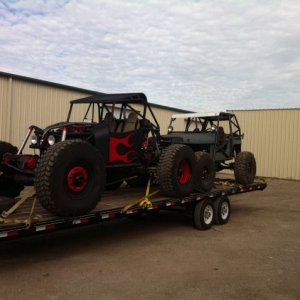
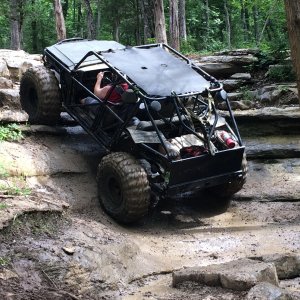
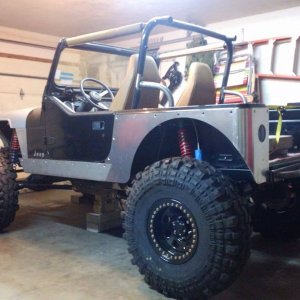
I'm entertaining the idea of running coil overs on my jeep jeep cj7. Not 100% sure on the weight of the rig but it will certainly be heavy to some standards. The drivetrain is a ford 460/np435/np203-np205 fully caged and usual trail gear, 1tons turnin 42 iroks on trailreadys. Any basic advice on what kind of spring rates I should be looking for when shopping the classifieds? This is a rock crawl purpose built rig btw. Thanks

You are using an out of date browser. It may not display this or other websites correctly.
You should upgrade or use an alternative browser.
You should upgrade or use an alternative browser.
School me on coil over springrates
- Thread starter Stokes
- Start date
Lots of numbers....
Weight of the vehicle, compressed spring height at optimum ride height, max spring extension you think you will see, and max compressed height in full stuff situations.
A really soft spring will need to be really long in order to support the weight of the vehicle, but if you compress it too much, it will bind. You also may not have enough spring perch height to fit that tall of a spring under the truck without major modding.
A stiffer spring wont need to be as long, but you will have a stiffer ride, and may not get the full spring extension you want unless you design it so the spring can leave the perch.
Say your front end weighs 2000lbs, thats 1000lbs each tire. Say you want a spring thats 10" tall at optimum ride height, and you find a spring thats rated for 200 pounds per inch spring rate. You would need that spring to be 15" tall, because it would take 5 inches of compression to equal the 1000lbs of weight it needs to support.
Depending on the spring, it may compress another 5 inches before it binds, so that would give you about 10" of spring travel from full expansion, to full compression.
I know on the broncoII's and rangers, they can get more expansion than the spring is tall, because they actually let the spring "float", and allow it to come off its perch, and they just use a long cone to guide the spring back into place once the vehicle levels back out. Limit straps keep them from completely coming apart. Gives them the ride height they want, the spring rate that can fit under the truck, but doesnt sacrifice the articulation and not as much fabbing of spring perches on the frame. These are not true "coil overs" because the coil isnt "over" anything. The shocks are separate from the coils.
So, I guess what Im saying is, measure up your wheel travel, your weight, and your spring perch distances at full droop and full stuff and then start looking at springs that match your numbers with a spring rate for your weight.
Weight of the vehicle, compressed spring height at optimum ride height, max spring extension you think you will see, and max compressed height in full stuff situations.
A really soft spring will need to be really long in order to support the weight of the vehicle, but if you compress it too much, it will bind. You also may not have enough spring perch height to fit that tall of a spring under the truck without major modding.
A stiffer spring wont need to be as long, but you will have a stiffer ride, and may not get the full spring extension you want unless you design it so the spring can leave the perch.
Say your front end weighs 2000lbs, thats 1000lbs each tire. Say you want a spring thats 10" tall at optimum ride height, and you find a spring thats rated for 200 pounds per inch spring rate. You would need that spring to be 15" tall, because it would take 5 inches of compression to equal the 1000lbs of weight it needs to support.
Depending on the spring, it may compress another 5 inches before it binds, so that would give you about 10" of spring travel from full expansion, to full compression.
I know on the broncoII's and rangers, they can get more expansion than the spring is tall, because they actually let the spring "float", and allow it to come off its perch, and they just use a long cone to guide the spring back into place once the vehicle levels back out. Limit straps keep them from completely coming apart. Gives them the ride height they want, the spring rate that can fit under the truck, but doesnt sacrifice the articulation and not as much fabbing of spring perches on the frame. These are not true "coil overs" because the coil isnt "over" anything. The shocks are separate from the coils.
So, I guess what Im saying is, measure up your wheel travel, your weight, and your spring perch distances at full droop and full stuff and then start looking at springs that match your numbers with a spring rate for your weight.
There are a few spring rate calculators to look at. The one on the FOA web site is fairly easy to use.
On my latest project, converting a TJ to Coil Overs. I think I went to light on my spring rates. I am not sure if I missed the angle of the CO, the length of the arms, the weight of the vehicle, bla bla bla....
I will prob buy another set of springs and hope to get it right the second time.
Talking to the vender you are buying your COs and springs from should help as well.
Another option for a trail only rig would be air shocks. Or even the Balistic combo air/CO. I thought about those as well.
On my latest project, converting a TJ to Coil Overs. I think I went to light on my spring rates. I am not sure if I missed the angle of the CO, the length of the arms, the weight of the vehicle, bla bla bla....
I will prob buy another set of springs and hope to get it right the second time.
Talking to the vender you are buying your COs and springs from should help as well.
Another option for a trail only rig would be air shocks. Or even the Balistic combo air/CO. I thought about those as well.

GaryTJ
Well-Known Member
The Foa site is pretty close for dual springs.
As a reference. My TJ weigh's just under 5k, 102 wheel base
I run 150 over 200 on the front and 200 over 250 on the rear. Front I am very happy with, rear a touch stiff.
As a reference. My TJ weigh's just under 5k, 102 wheel base
I run 150 over 200 on the front and 200 over 250 on the rear. Front I am very happy with, rear a touch stiff.
Keep in mind when you weigh your vehicle, that your wheels and tires and axles are considered unsprung weight. You need to subtract the weight of your wheels/tires and axles from your overall vehicle weight, or you could end up with a spring that is too stiff.
This may not be an issue if you just have cheapy rims and small tires, but if you have a killer set of monster tires, tubes, calcium, and heavy beadlocks, and heavy axles you could end up with a thousand pounds of unsprung weight that can mess with your math if you dont take that into consideration.
This may not be an issue if you just have cheapy rims and small tires, but if you have a killer set of monster tires, tubes, calcium, and heavy beadlocks, and heavy axles you could end up with a thousand pounds of unsprung weight that can mess with your math if you dont take that into consideration.
Binder
Well-Known Member
Lots of numbers....
Weight of the vehicle, compressed spring height at optimum ride height, max spring extension you think you will see, and max compressed height in full stuff situations.
A really soft spring will need to be really long in order to support the weight of the vehicle, but if you compress it too much, it will bind. You also may not have enough spring perch height to fit that tall of a spring under the truck without major modding.
A stiffer spring wont need to be as long, but you will have a stiffer ride, and may not get the full spring extension you want unless you design it so the spring can leave the perch.
Say your front end weighs 2000lbs, thats 1000lbs each tire. Say you want a spring thats 10" tall at optimum ride height, and you find a spring thats rated for 200 pounds per inch spring rate. You would need that spring to be 15" tall, because it would take 5 inches of compression to equal the 1000lbs of weight it needs to support.
Depending on the spring, it may compress another 5 inches before it binds, so that would give you about 10" of spring travel from full expansion, to full compression.
I know on the broncoII's and rangers, they can get more expansion than the spring is tall, because they actually let the spring "float", and allow it to come off its perch, and they just use a long cone to guide the spring back into place once the vehicle levels back out. Limit straps keep them from completely coming apart. Gives them the ride height they want, the spring rate that can fit under the truck, but doesnt sacrifice the articulation and not as much fabbing of spring perches on the frame. These are not true "coil overs" because the coil isnt "over" anything. The shocks are separate from the coils.
So, I guess what Im saying is, measure up your wheel travel, your weight, and your spring perch distances at full droop and full stuff and then start looking at springs that match your numbers with a spring rate for your weight.
Um....the topic is coilover springs. No cones, floats, guides, binds, etc....
Um....the topic is coilover springs. No cones, floats, guides, binds, etc....
um, hence the disclaimer at the end of my paragraph about that particular setup not being a coil over, but the rest of the info still holds true. He's got some measuring to do.
Cool off man, this heat is getting to you.
pos97TJ
Well-Known Member
I find it easiest to mount the shock and run your stops down, put on one spring and set the rig on its weight. Measure how much the spring squished and do the math to figure your spring rate. Figure out how much up/down travel you want and get the spring rates that will accomadate you. The corner wieght of your jeep is a good starting point but if your shocks arent mounted vertically then there is leverage you need to compensate for. Keep in mind that if you are going to have very little up travel that you will need to run a tender coil on top to keep the pressure on the springs when the are unloaded. I am no expert but this seems to work for me:awesomework: If you buy them new alot of people will exchange them if the rate isnt what you want aswell.
Last edited:

Joey for reference my rig with tools and full tank of gas weighs 4750.
there is also a thread on pirate where you can trade springs with others who are learning and experimenting if you guess wrong.
i went to S&N and talked with jason and trevor, but guess you cant do that. maybe another fab shop?
talk to someone who has a rig similar that works?
there is also a thread on pirate where you can trade springs with others who are learning and experimenting if you guess wrong.
i went to S&N and talked with jason and trevor, but guess you cant do that. maybe another fab shop?
talk to someone who has a rig similar that works?
wow lots of good info! i have been off tryin to be a good bestman for the last few days for my now married buddy  hey choptop thanks for the nice bit of info up top that helps with the fact that coils are always a option depending on how well i can keep things moderately in budget. but this gives me lots to start chompin on. i should be choppin tube here soon for links so we shall see what i come up with
hey choptop thanks for the nice bit of info up top that helps with the fact that coils are always a option depending on how well i can keep things moderately in budget. but this gives me lots to start chompin on. i should be choppin tube here soon for links so we shall see what i come up withJoey for reference my rig with tools and full tank of gas weighs 4750.
there is also a thread on pirate where you can trade springs with others who are learning and experimenting if you guess wrong.
i went to S&N and talked with jason and trevor, but guess you cant do that. maybe another fab shop?
talk to someone who has a rig similar that works?
ha if yours weighs in a shade under 5k i guess mines gonna be more of a fatty than i was hopin ha. i did notice that post on pirate gotta love resources! just the coil numbers are still alittle over my head but im working to change that.
wow lots of good info! i have been off tryin to be a good bestman for the last few days for my now married buddy
no problem. I just went thru some of the same stuff, but on my 53 f100 pickup. Granted, Im not dealing with the longer lengths you will be (I have about 4" total travel!), and my setup involves some geometry because of the A-arm setup (the farther from vertical the coil over is, the higher the spring rate needs to be to achieve the same ride height), but the basics are the same. Weight, and lots of measuring, and some math.
Binder
Well-Known Member
Swayaway has some spring rate formula stuff on their web site. No not calculators as you have to do the math your self.:awesomework:


![Image10222012202553[0].jpg](http://attachments.www.hardlinecrawlers.com/xfmg/thumbnail/2/2081-4000bbe30044f090b0617aaa9f4355a7.jpg?1625928244)